On this page:
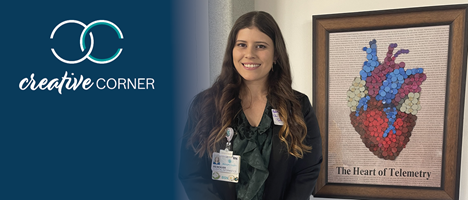
Rebekah Castell’s journey at Advocate Health is one shaped by care, curiosity and creativity. Over the past seven years in Charlotte, North Carolina, she has grown from a certified nursing assistant to a registered nurse and now serves as a clinical informaticist supporting Epic. Along the way, she’s experienced firsthand what it looks like when an organization truly invests in its people. Rebekah credits Advocate Health’s culture of internal growth and support for giving her the confidence and opportunity to keep building a career she’s proud of.
That same sense of intention carries into her art.
During her time as a bedside nurse in Telemetry, Rebekah worked closely with heart failure patients, an experience that left a lasting impression. When she began thinking about her first mixed-media art piece, she knew she wanted it to reflect that chapter of her life. Over time, she started collecting medication caps, drawn to their range of colors and shapes. What began as a small curiosity slowly took on meaning. Together, the caps reminded her of a mosaic – many individual pieces coming together to form something whole.
From there, the vision became clear.
Rebekah decided to create an anatomically correct heart, sketching the design and carefully blending colors to define each section. Placing all 347 medication caps felt like assembling a puzzle, with each one finding its place. For the background, she turned to something deeply familiar: telemetry strips. The recorded rhythms of the heart reminded her of music, each beat carrying tempo and flow. That connection inspired her to dive deeper into cardiac physiology and layer musically descriptive words into the background, adding another dimension of meaning to the piece, which she titled, The Heart of Telemetry.
Outside of work and art, Rebekah is also a parent to a three-year-old daughter, who inspires much of what she creates. Her artwork often carries a personal purpose, created with her child in mind. Through one of Creative Corner’s programs, Rebekah has found not only a space to share her work but also a community. At last year’s Teammate Art Show, she connected with fellow artists, exchanged stories and formed new friendships. Her heart piece was first displayed at Atrium Health Lincoln in Lincolnton, North Carolina before being featured in the in-person art show.
This mixed-media heart marked Rebekah’s first major art project and took two to three months to complete. Looking ahead, she’s excited to continue exploring her creativity through painting and hopes to collaborate with other artists as time allows. More than anything, Rebekah looks forward to staying connected – using art as another way to reflect, express and build community.
Interested in learning more about Creative Corner? Fill out this form to get involved today!
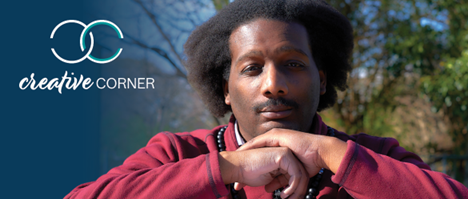
In a swirl of images and verse, Tahj Jones captures the heart and mind with his poetic-photographic work, Drops of Life, which took home Best in Show at the Teammate Art Show last year. But Tahj’s story stretches far beyond his art.
Tahj joined the organization during the early days of the COVID-19 pandemic, working remotely with the call center. After two years, he transferred to the lab, supporting scientific discovery by processing samples, running cytometers, organizing supplies and maintaining critical storage systems. Recently, he pivoted into a new role that supports his goal of returning to school to complete his degree and earn a Medical Laboratory Certification.
But Tahj is more than the sum of his titles. He’s a philosopher at heart. “Barely a drip out of the faucet or full blast,” as he puts it—and art is how he opens conversations that many shy away from. Drops of Life is a quiet call to connection, layering poetry with photography to explore individual journeys within the collective story of community. “It’s not about being poetic,” Tahj says. “It’s about having a conversation.”
His creative approach is intentional: poetry for its emotional density and brevity, photography for its visual storytelling. Together, they weave a narrative inviting viewers to reflect, relate and respond. The piece doesn’t demand answers; it offers perspective. “We all walk different paths,” Tahj shares, “but we need each other to be whole.”
He sees his work as a platform for inclusion and empathy, where dialogue—verbal and non-verbal—can lead to mutual understanding. It’s also deeply personal. Tahj confronts generational trauma, societal tension and emotional isolation with the courage of someone unafraid to ask the hard questions. His art doesn’t try to solve every problem—it just asks us to look.
Outside of his current role and studies, Tahj explores how science, spirit and art converge into storytelling. He dreams of building an AI-integrated program to push those ideas even further. “There’s no real place for philosophy in modern society,” he reflects, “but I find it everywhere, in people you’d never expect.”
Tahj credits those unexpected teachers—cafeteria workers, environmental service workers, security guards—as the quiet philosophers of daily life. Their wisdom sparked his journey into photography, following in the footsteps of his father, a photographer himself. Though Tahj admits he doesn’t love photography for photography’s sake, he treasures what it makes possible: empathy, curiosity and conversation.
At his core, Tahj is on a mission to create hope. Not just in the world, but within himself. His art is his offering, a vessel for the kind of transformative conversation he believes we all need. “If you're thinking about it, you're talking about it,” he says. “And if you’re talking about it, you're growing.”
That growth is evident in Drops of Life. And if Tahj’s trajectory is any indication, he’s only just begun.

